- functions: sun radiation meter
- measurement: radiation intensity
- wide scope of work temperatures
- two cable connection
- result transmission to long distances
- cooperation with sensors:
- Kipp & Zonen
- semiconductor diode
|
|
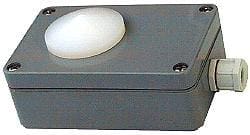
Radiation meter LB-900 is designed for sun radiation intensity measurement in different spectral scopes. The meter is composed of a measurement system microprocessor and an external sensor, where in version LB-900 - the device is one channel and in version LB-901 - two channel. The meter is a stationary device, of small size, powered from an outside power supply.
The device uses sensors: produced by the Kipp & Zonen company (scope of visible radiation), produced by the Macam Photometrics Ltd company (ultraviolet radiation sensors) or a silicone photo diode. The signal measurement coming from the sensor is performed using a high accuracy analogue- digital converter. Basing on the measured sensor voltage and digital calibration data memorized during calibration in the device's memory, the microprocessor built in the device counts the actual radiation intensity measurement result. In case of lack of information concerning the type of a sensor attached - the device sends the measurement intensity result from the attached sensor (in mV). The results are sent from the device in a digital form to a supervisory system of data collection.
The device is equipped with a digital current interface and its time course is analogous to RS232C standard. Such interface beside data transmission is also used for powering the meter - using two cable connection for this purpose (i.e.: telephone type), but the polarity of attaching the interface's cables is optional.
Using interface the device can be attached to any system of data collection i.e. by using a converter LB-371 for interface RS232C of any computer for a meteorological station LB-741 or for a converter LB-486. It allows on remote control and automatic collection of measurement data.
The device does not have any mechanical calibration elements (i.e.: potentiometers). Device calibration is performed by sending calibration data obtained in the model climate conditions or data given in a metric attached to a sensor through a digital interface to a non-volatile memory of the device or data provided in the specification of an attached sensor. It guarantees comfort and high calibration accuracy as well as stability of the device's meteorological parameters in time.
Radiation meter LB-900/LB-901 is made in a silicone filing compound, which makes it resistant to open field conditions.
| MEASUREMENT PARAMETERS |
|
|---|---|
| Scope of input voltages |
-10...+10 mV / -1,25...+1,25V |
| 0...20 mV / 0...2,5 V | |
| Accuracy |
0,05 % |
| WORK CONDITIONS |
|
|---|---|
| Temperature |
-30...+70 °C |
| Humidity | 0...100 % |
| POWER SUPPLY |
||
|---|---|---|
| Scope of voltage |
8..24 V DC | |
| Energy consumption |
4 mA | average |
| 25 mA | maximum | |
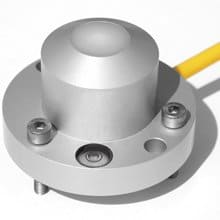
| SP LITE-2 PYRANOMETR - Sun radiation sensor - Kipp & Zonen | |
|---|---|
| SP LITE sensor is designed for sun radiation measurement in
the visual scope and close infrared from the semicircular zone. The
measurement is performed on a routine basis in any climate conditions.
The sensor is made out of high class silicone photo diode placed in an
aluminum casing closed from the top by a conical, semi clean window,
which dissipates the radiation (so called diffuser). Because of the
diffuser's unique construction the sensor SP LITE sensitivity is
proportional to the angle cosine of the sun radiation incidence. The
sensor construction assures device's reliable work for many years. |
 |
| Sensitivity | 100 uV/W/m2 |
| Scope of measurement |
0...2000 W/m2 |
| Spectrum scope |
0,4...1,1 um |
| Scope of work temperatures |
-30...+70 °C |
| Constant response time |
< 1 sec |
| Temperature measurement dependency | +/- 0,15 %/°C |
| Cosine error |
< 10% (in the scope 0...+80 °C) |
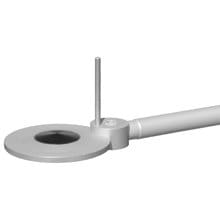
| NR LITE 2 BILANSOMETR - Difference sensor - Kipp & Zonen | |
|---|---|
| NR LITE sensor is designed for routine balance measurements
(difference) between the incident and returning sun radiation. The
sensor can work in any climate conditions. The sensor is made out of
high class thermoelectric stock placed in an aluminum casing closed
from the top and from the bottom by conical, semi clean windows, made
out of teflon coated with black absorbing surface. The absorbing
surfaces in the sensor NR LITE are specially prepared for obtaining
high stability of the sensor parameters when working in various
environmental conditions. Because of the special thermstock
construction the output signal from the NR LITE sensor is directly
proportional to the difference between the incident and reflected
radiation. The sensor construction assures device's reliable work for
many years. |
 |
| Sensitivity | 10 uV/W/m2 |
| Scope of measurement |
-2000...+2000 W/m2 |
| Spectrum scope |
0...100 um |
| Scope of work temperatures |
-30...+70 °C |
| Measurement accuracy (sensor asymmetry) |
+/- 10...20 % |
| Constant response time |
20 sec |
| Direction error |
< 30 W/m2 (in the scope 0...60 °C, 1000 W/m2) |
| Instability |
< +/- 2%/year |
| Nonlinearity |
< 1% do 2000 W/m2 |